|
Back to Introduction
IT Needs to Consolidate Wireless (Continued)
|
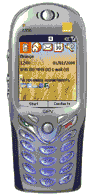
| Orange's new SPV E200 Smartphone, expected to ship this month |
|
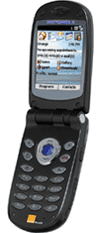
| The Motorola MPx200 |
Europe Leapfrogs the U.S.
Q: Although both of these new phones are exciting, we again see the Europe device leapfrogging what is offered in America. The Orange Smartphone has Bluetooth, a camera, the CF, and OS improvements such as faster performance. While the Motorola Smartphone has a nice clamshell design and a smaller size, it has software that is a generation behind. Why is there still such a huge differential between the devices we see in the U.S. and those in Europe—where you come from?
JC: Partly, it is cost. As soon as you add a VGA camera module you increase the cost dramatically, and Bluetooth adds cost as well. Different device manufacturers choose different configurations.
You will see a wide variety of devices. Some will include WiFi and wide area radio, but some will have only WiFi. This will give enterprises choice. You don't necessarily want a factory worker to have a GPRS radio and be able to run up big bills [for data access].
That's the sort of wonderful differentiation we were hoping would happen.
Q: Do you expect to see more device types using Smartphone? Certainly in mobile devices, there are far more form factors than we see in the PC world—many for different uses, but also just as a matter of style. With the Smartphone we've seen only a candybar and now the first clamshell.
JC: Absolutely. I have the opportunity to see the road maps from these vendors, and there is a great deal of differentiation happening. This is important. Mobile devices are a different business from PCs. First, the lifetime is much shorter: Mobile devices are used only for 18 to 24 months. Differentiation continues to drive mobile devices.
I was walking through Geneva last week with one of my colleagues looking at watches. What better place to look at watches than Geneva? We were struck by the differentiation that watchmakers have been able to maintain for hundreds of years, even though all watches essentially have the same purpose. They tell the time, perhaps the date, and some of the really fancy ones can tell you the altitude, but essentially they're all timepieces. Yet there is amazing differentiation and the margins are good in that business.
This is great for the enterprise market, because it means you'll be able to get what you need. If you want a waterproof device to use in the petrochemical business, I bet that is going to come. It already exists in the Pocket PC business.
Q: The layers in this industry seem to have conflicting business models. The device manufacturers want you to buy phones every six months and turn generations around, obsoleting devices as fast as possible. The carriers see phones as something they have to subsidize and would rather sell you upgraded services. IT wants to amortize devices over three years. How are these contrary forces reconciled?
JC: That's a great question, and one we have thought a lot about. You don't want to solely be on the carriers' "L" line of their P&L. Every time you get a new device into the hands of new users, it costs them money because they subsidize the devices.
But when people buy a new device, ARPU (average revenue per user) goes up. Operators want new devices both to keep your account and to sell you new services. So operators aren't as unhappy about the replacement ratio as one might think. But in the end, it is what the enterprises want that will matter. If they want to replace devices every three years, then they will. It matters less what we and the operators think. We'll continue to provide new devices with ever better features. I don't think we'll see a big clash of three different business models because the driver is the customer at the end of the value chain.
Q: Carriers' approaches to control of the devices' software varies widely. For example, in Orange's wall-and-garden model it demands complete control of software distributed to a device, while AT&T leaves devices wide open. IT has concerns, because it wants to deliver custom solutions. What are the tradeoffs?
JC: Enterprises, regardless of their size, need to carefully select what network provider they work with based on the business and technical drivers in that enterprise. If you want a high level of control over what is downloaded, then Orange, as an example, is good at seeing that what is mandated gets into the phone. But there is also the cost side of things. Enterprises still buy SIM cards and phones from many different sources. This makes the systems side extremely difficult.
It is an advantage to focus on one operator—or in large enterprises, two operators—because of coverage issues. Know exactly what your business drivers are. Carriers, more so in Europe and Asia, have technical staff that can sit down with you and work through your issues. Of course, the bigger the enterprise, the more support you get.
Don't forget that software will be written not only for the device but for the network as well. Many of the network services will be made available as Web services that you can write to from Visual Studio. The more custom your solution is, the more you want to engage with the carrier.
Q: When you were at Symbian, which you co-founded, that company's position was that the industry needed its EPOC because mobile devices require a much more reliable OS than what Microsoft provided on the desktop. Now that you're on the other side, is Microsoft meeting that challenge?
JC: Absolutely. Our Windows Mobile software for Smartphone was built specifically to provide a great, reliable mobile phone experience while also providing a powerful platform to support rich functionality and new applications and services. It's really a combination of what's great about a mobile phone and what's great about the flexibility and power of a PC. It's not an attempt to re-create the PC on a phone.
Q: Analysts project that 7 million Symbian-based devices will ship this year. Microsoft has a later start, but when do you expect to catch Symbian? What is your goal, or stated differently, what unit shipments must Smartphones achieve to have sufficient critical mass to be a leader in a market with 500 million mobile devices a year?
JC: We think this is still a market in its early stages and that the percentage of data-capable phones in relation to the overall number of phones that ship is going to continue to increase as the cost of goods come down, as the applications and services proliferate, and as more people try them and find out how useful it is to have a familiar software experience on a phone and to have all your important information with you on the go.
Without getting into specific market projections, I'll just say that we're optimistic about the potential for this category of product and the potential for our Windows Mobile platform to do quite well. In the end, we think software and developers will be the key differentiator and we're comfortable with our ability to compete with Symbian and others on the basis of a strong development platform and software in general.
About the Author
Jim Fawcette is president of Fawcette Technical Publications, Inc., publisher of FTPOnline.
Back to top
|