|
Luminaries Debate Issues, Opportunities (Continued)
Top Issues Facing Java
Phipps asked everyone to conclude the Technology Roundtable by summarizing their thoughts into something that folks could take away from the event.
McGovern said the earlier notion of "write once, test everywhere" is a fallacy. "Ease of use" is the new mantra: Indeed, it's critical. Integration technology must be open. The whole nature of integration implies spanning proprietary stacks. We must work hard to keep portal and integration servers open, he said.
Litwack said there's too much focus on technology. To paraphrase that famous political slogan, "It's the apps, stupid." IT has reached a crisis of complexity; the old architecture is collapsing and a services-oriented architecture (SOA) is evolving. Learn from Microsoft, he said, which is selling .NET as an SOA. He likened SOA to a second-phase rocket for Java.
Hamilton stressed the need to grow the developer base. It's not just a tools problem, but a matter of simplifying the APIs. Java has captured the enterprise market; now it's time for it to move on to other markets.
|
|
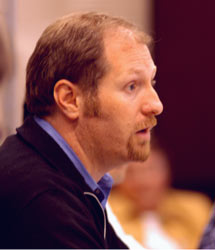
Borland's Ted Shelton identified the reality of open source: "People are downloading free things from developers' sites, not from open-source vendors."
|
Lycklama wanted to make Java easier to use. "Unix won the server market because it was powerful, not because it was easy to use. Microsoft won the desktop market because it was easy to use, not because it was powerful. We're now at a convergence where we need tools that are powerful and easy to use," he said.
Chappell said the Java community needs a new model beyond the application server stack. It needs to focus on standards, and JSR 208 might be key to that end.
Shelton warned that the greatest danger to Java is not Microsoft but IBM, which not only has 35 to 55 percent of the application server market, but didn't even bother to come to JavaOne. So the concern is, "Where are they taking the community without us?" IBM is taking the proprietary lead of the server market, he said, and they have a shot at succeeding. "The rest of us could become the poor distant cousins," he said.
ATG's Fumi Matsumoto hoped for a Java platform on which applications could live for a long time. Because many J2EE applications are customer-facing, they evolve to meet changing customer needs. "We haven't been focused [enough] on customers, just developers," he said.
Farrell agreed with Hamilton that we need to expand the developer base. "Focus on developers with different skill levels," he said.
Naddell said it's important to focus on the needs of the purchasing end users. The top four reasons for service adoption are quality of service, reliability of service, support, and ease of use. MIDP 2.0 is a good start, but the UI and controls need to be identical across products and platforms.
Renaud said Java is healthier than ever. Community has been its greatest strength and .NET spurs Java's innovation. "Ease of development and ease of integration will deliver value to customers," he said.
Finally, Phipps observed that discussing Java automatically means inviting many different vendors to the table. By contrast, discussing .NET means inviting only one vendor to the table—even though, as everyone humorously agreed, there might be as many people sitting at it. "What's encouraging is that there is a discussion," Phipps said.
A full transcript of the Java Technology Roundtable will appear in the October issue of Java Pro.
About the Author
Stefan Gruenwedel is a contributing editor to Java Pro and a technology writer and editor for Fawcette Technical Publications, DevX, and Macromedia.
Back to top
|