
Dueling Whiteboards
Intriguing solutions are the big draw at the Enterprise Architect Summit 2004 Whiteboard Invitational.
by Terrence O'Donnell
Enterprise Architect Summit, June 8, 2004
Five enterprise architects put their ideas and solutions to the test in a friendly contest at the Enterprise Architect Summit 2004 Whiteboard Invitational on the evening of June 7, following a jam-packed day of conference events. The Whiteboard Invitational was an entertaining way to bring to life the Whiteboard guest feature that appears on the back page of each Enterprise Architect issue. Each contestant was given 10 minutes to present an idea or problem and solution, and diagram it on a classic whiteboard. The event was moderated by Dan Ruby, Enterprise Architect's editorial director.
The contestants included Toufic Boubez, CTO for Layer 7 Technologies; Dave Hollander, CTO for Contivo; Chris Keene, CEO for Persistence Software; David Linthicum, CTO for Grand Central Communications; and Mark O'Neill, CTO for Vordel. Among them, Boubez, Hollander, Keene, and O'Neill were past guest authors for the magazine's Whiteboard feature, and Boubez, Keene, and O'Neill used diagrams and presentations similar to those they described in the magazine. Hollander chose to go with a different presentation that simulates the way in which he goes about whiteboard diagramming in his office when discussing ideas with colleagues. Linthicum was a recent contest entrant who brought a fresh perspective on semantics to the evening's festivities.
Each whiteboard diagram and presentation was judged for clarity, originality, and significance to enterprise architecture by a panel of judges who assigned numerical scores from 1 to 5 for each category. The panel included noteworthy peers in the enterprise architecture space: ZapThink's Jason Bloomberg, Meta Group's Thomas Murphy, Burton Group's Peter O'Kelly, ZapThink's Ron Schmelzer, and Compuware's Peter Varhol, who is also a contributing editor for FTP's Java Pro.
First up was Dave Hollander, who sought to engage the audience in some interaction over the issue of semantics as the central problem of defining data. He began by defining semantics as "when data and process interact in a given context to achieve a desired result." Around the big red "S" for semantics in his diagram Hollander drew the ontology, XML point of view, and database perspectives, providing details for each:
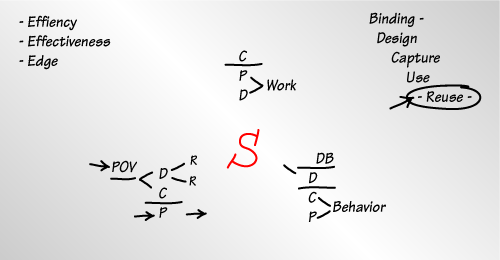
Hollander's Holy Grail
For example, for the XML perspective, data and context are bundled together into artifacts from which can be assumed a variety of processes and concepts that lead to information reuse. In contrast, the database world normalizes information into nothing but data. The crux of Hollander's presentation was the concept of reuse, which he termed as "the Holy Grail of information architecture." Hollander concluded his presentation asking for a show of hands: Which category provided the ability to go back and reuse information that is unintuitive and find new insights? The consensus was that all three categories—ontology, XML, and database—were necessary to achieve this solution.
Going Deep
Next up at the whiteboard was Toufic Boubez, who prefaced his presentation with a nod to the Saturday Night Live "Deep Thoughts" routine by saying that his solution, innocuous but surprisingly powerful, would demonstrate his deeply held belief that systems must be flexible. The intent, he said, should be to build loosely coupled systems. He started with a simple Web service that performs a specific task, and then proceeded to show where it would break down and what could be done to change it:
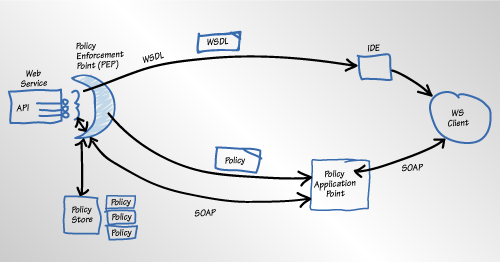
Boubez Focuses on Flexibility
The discussion progressed to what can occur when certain terms and conditions are imposed on the use of the Web service, such as credentialing and encryption, and then he listed the other items desired for the Web services. Boubez said that you eventually end up with a policy, or a "mechanism to take out the stuff [you] don't want in the business logic of the server." The information that remains in the policy document is put into a policy layer that Boubez diagrammed as the "policy enforcement point," effectively decoupling the service from the rest of the world.
This result raised the question about the client side, and why decoupling must apply only to the server side. Admitting to being a mechanic hobbyist, Boubez likened the situation to a drive shaft with only one CV joint. The answer was to decouple the client side with a "policy application point," creating a symmetrical solution to Boubez's "Deep Thoughts" proposition.
The third contestant to step up to the whiteboard was Christopher Keene. Like Boubez, Keene presented a solution that is similar to the presentation he wrote about in Enterprise Architect. Keene focused on a tough enterprise problem in a financial context in which the trading equities part of the business had multiple application platforms and an entire data center:
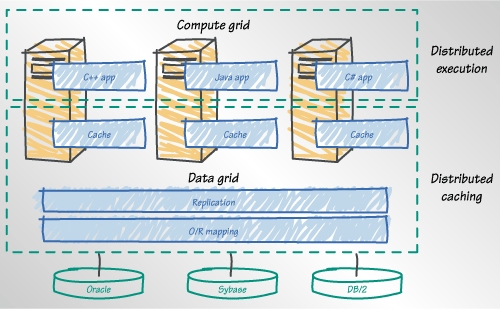
Keene on the Data Grid
Keene revealed up front that he would work toward the data grid as a solution. According to Keene, data grids are being applied to just about every distributed system, and he defined a data grid as "building a system where a variety of computers get sufficient access to data in a distributed setting." The key to Keene's solution is building an O/R mapping layer, a replication layer, and caching. Relational data is mapped to an appropriate object for each type of application, and replication ensures that each cache is constantly updated.
Keene said that the "challenge of SOA is to rip apart data silos and ensure every application has a real-time view of the architecture." As a bonus, Keene completed his presentation with two minutes to spare.
In his turn at the whiteboard, Mark O'Neill covered another Web services security scenario that addressed a similar upcoming installation he will undertake for a client later in the week. O'Neill's diagram, in a layout similar to his presentation in the Spring 2003 issue of Enterprise Architect ("Mapping Security to a Services-Oriented Architecture"), included a horizontal arrangement of the consumer, access, services, adapters, and business systems layers:
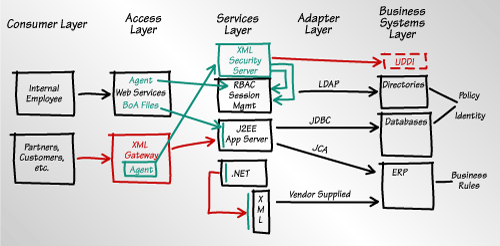
O'Neill's Security for Web Services
O'Neill demonstrated that you can use an XML security server, with links to existing security architecture, to pass security context with XML messages through a services layer by way of directory reuse instead of creating a new silo for Web services.
Crystal Clear
David Linthicum made the final presentation of the evening, and he used the opportunity to return to the topic of semantics. Linthicum started out with some interaction with the audience, asking if anyone present had a single definition for the customer or a single definition for a sale. His point was clear: We all have different definitions for data and no common understanding for how to define it. And SOAs, according to Linthicum, "are exacerbating the problem."
Linthicum began diagramming his "magical" solution by representing the creation of local semantic domains, but because metadata "doesn't get us where we want to go," he represented the extensions of creating the community domain, and the vertical domain. The flow indicated that the community domain inherits semantics from the local domain, and the vertical domain inherits semantics from the community domain. Linthicum continued by diagramming "the almighty repositories" in addition to transformation/mapping, runtime execution, and process layers, with toolsets and security rounding out the solution diagram:
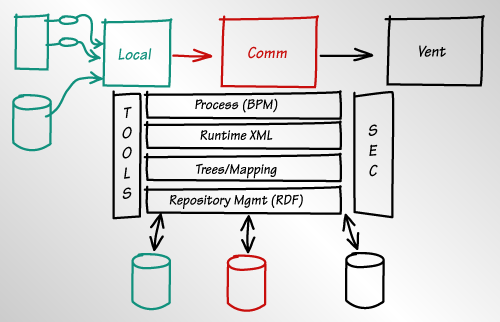
Linthicum Drives Semantics
Victory was spread out among the participants. Linthicum had the best overall score (59) as well as the top score for the clarity category (24). The originality category drew a tie with a best score (19) shared by Boubez and Hollander. And best score (19) for the significance-to-enterprise-architecture category drew a three-way tie among Boubez, Keene, and Linthicum. Congratulations to all participants for a great event.
About the Author
Terrence O'Donnell is managing editor of Enterprise Architect.
|