Dueling Whiteboards (Continued)
Going Deep
Next up at the whiteboard was Toufic Boubez, who prefaced his presentation with a nod to the Saturday Night Live "Deep Thoughts" routine by saying that his solution, innocuous but surprisingly powerful, would demonstrate his deeply held belief that systems must be flexible. The intent, he said, should be to build loosely coupled systems. He started with a simple Web service that performs a specific task, and then proceeded to show where it would break down and what could be done to change it:
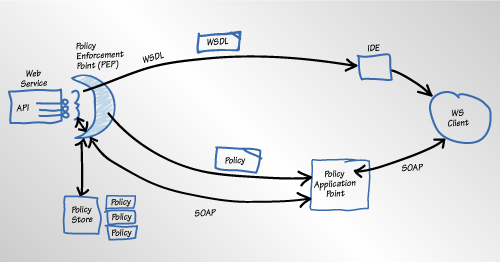
Boubez Focuses on Flexibility
The discussion progressed to what can occur when certain terms and conditions are imposed on the use of the Web service, such as credentialing and encryption, and then he listed the other items desired for the Web services. Boubez said that you eventually end up with a policy, or a "mechanism to take out the stuff [you] don't want in the business logic of the server." The information that remains in the policy document is put into a policy layer that Boubez diagrammed as the "policy enforcement point," effectively decoupling the service from the rest of the world.
This result raised the question about the client side, and why decoupling must apply only to the server side. Admitting to being a mechanic hobbyist, Boubez likened the situation to a drive shaft with only one CV joint. The answer was to decouple the client side with a "policy application point," creating a symmetrical solution to Boubez's "Deep Thoughts" proposition.
The third contestant to step up to the whiteboard was Christopher Keene. Like Boubez, Keene presented a solution that is similar to the presentation he wrote about in Enterprise Architect. Keene focused on a tough enterprise problem in a financial context in which the trading equities part of the business had multiple application platforms and an entire data center:
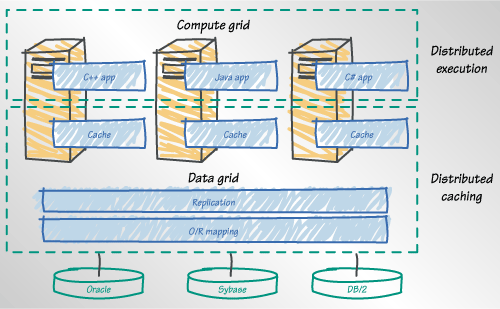
Keene on the Data Grid
Keene revealed up front that he would work toward the data grid as a solution. According to Keene, data grids are being applied to just about every distributed system, and he defined a data grid as "building a system where a variety of computers get sufficient access to data in a distributed setting." The key to Keene's solution is building an O/R mapping layer, a replication layer, and caching. Relational data is mapped to an appropriate object for each type of application, and replication ensures that each cache is constantly updated.
Keene said that the "challenge of SOA is to rip apart data silos and ensure every application has a real-time view of the architecture." As a bonus, Keene completed his presentation with two minutes to spare.
Back to top
|